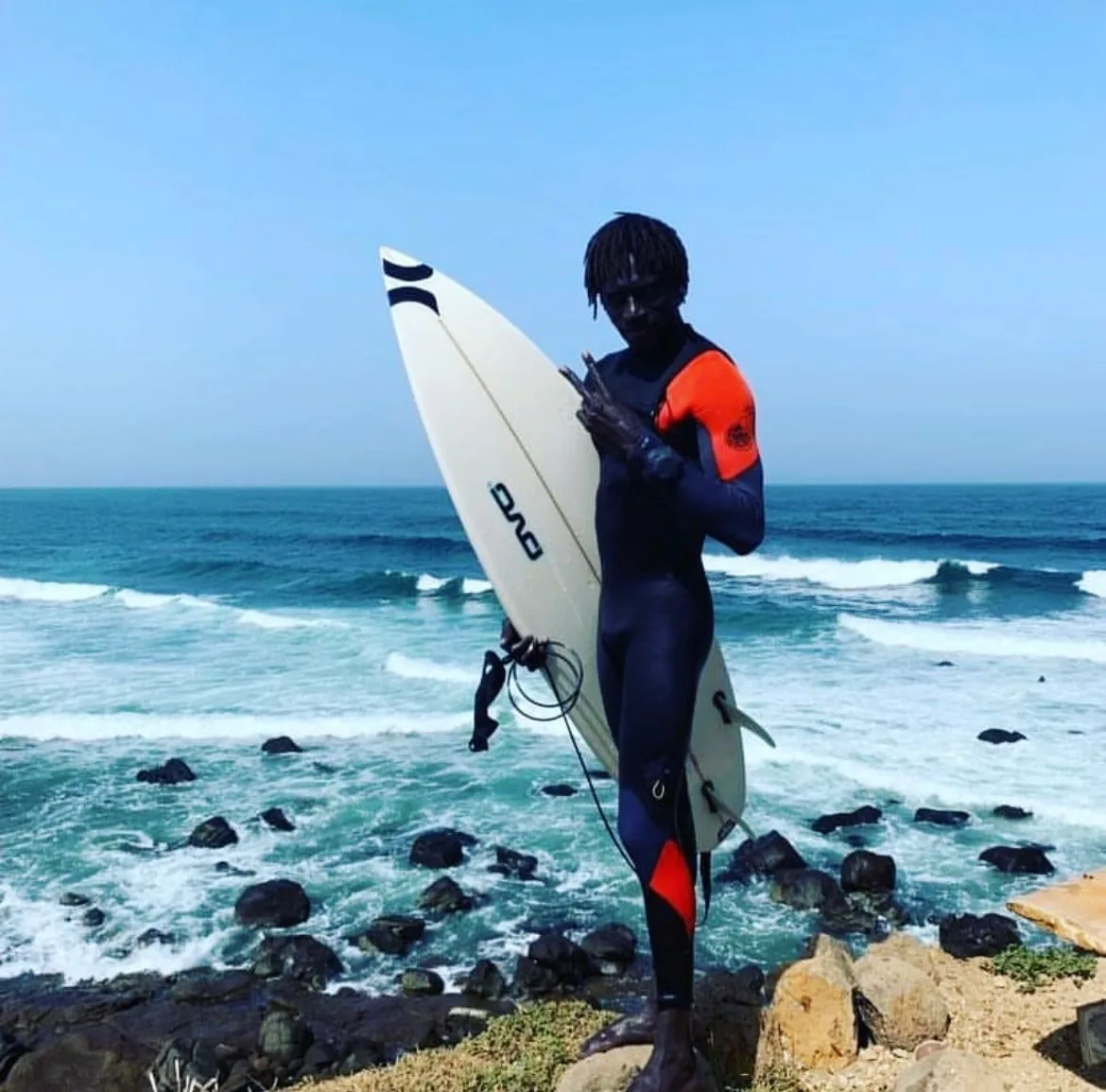
Ngor Island History & Culture
Just off the tip of Dakar’s Cap-Vert peninsula, Ngor Island, or Île de Ngor, is tiny on the map and enormous in cultural meaning. In a matter of minutes, the short pirogue crossing from the mainland carries you from the traffic and density of the capital to an island with no cars, sandy lanes, sea air, painted walls, fishing boats, and one of the most storied surf line-ups in Africa. For Senegalese visitors, Ngor is a familiar place of weekend escapes, family meals, and ocean tradition. For surfers, it is almost mythical, thanks to the wave known as Ngor Right and its appearance in The Endless Summer.
Yet the island is much more than a surf spot. Ngor’s identity was shaped by Lebu fishing culture, Islamic practice, Dakar’s urban expansion, and the Senegalese ideal of teranga, the art of generous hospitality. Today, you can still watch fishermen launch painted pirogues at dawn, hear the call to prayer drift over the water, and share attaya tea in the late afternoon, even as surf schools, guesthouses, and camps welcome a growing international crowd.
For travellers wanting to understand the island rather than simply pass through it, Ngor rewards slow attention. Stay a few days, walk every lane, greet people properly, and let the rhythms of the place reveal themselves. For surfers, Ngor Surfcamp Teranga is an ideal base, combining sea views, daily Senegalese meals, boat transfers, and guided access to the island’s famous breaks.
Geography, origins, and the pre-colonial island
Ngor Island lies roughly 400 metres off the coast of Dakar’s Almadies district, in the Atlantic waters at the westernmost edge of mainland Africa. The crossing takes about 5 to 10 minutes by local boat, usually costing around 1,000 to 2,000 XOF per person depending on time, luggage, and season. The island itself is small enough to cross on foot in under half an hour, but its compact size hides a long history of seafaring knowledge and social continuity.
Before Dakar became the giant city it is today, this coast was shaped by the lives of the Lebu people, one of Senegal’s historic coastal communities. The Lebu developed a culture deeply tied to fishing, marine navigation, and local spiritual geography. Villages along the peninsula, including Ngor on the mainland and the island opposite it, were linked by kinship, trade, and ocean labour. Fishing was not simply an occupation. It was a way of organising time, family, and status. The sea provided food, income, and identity.
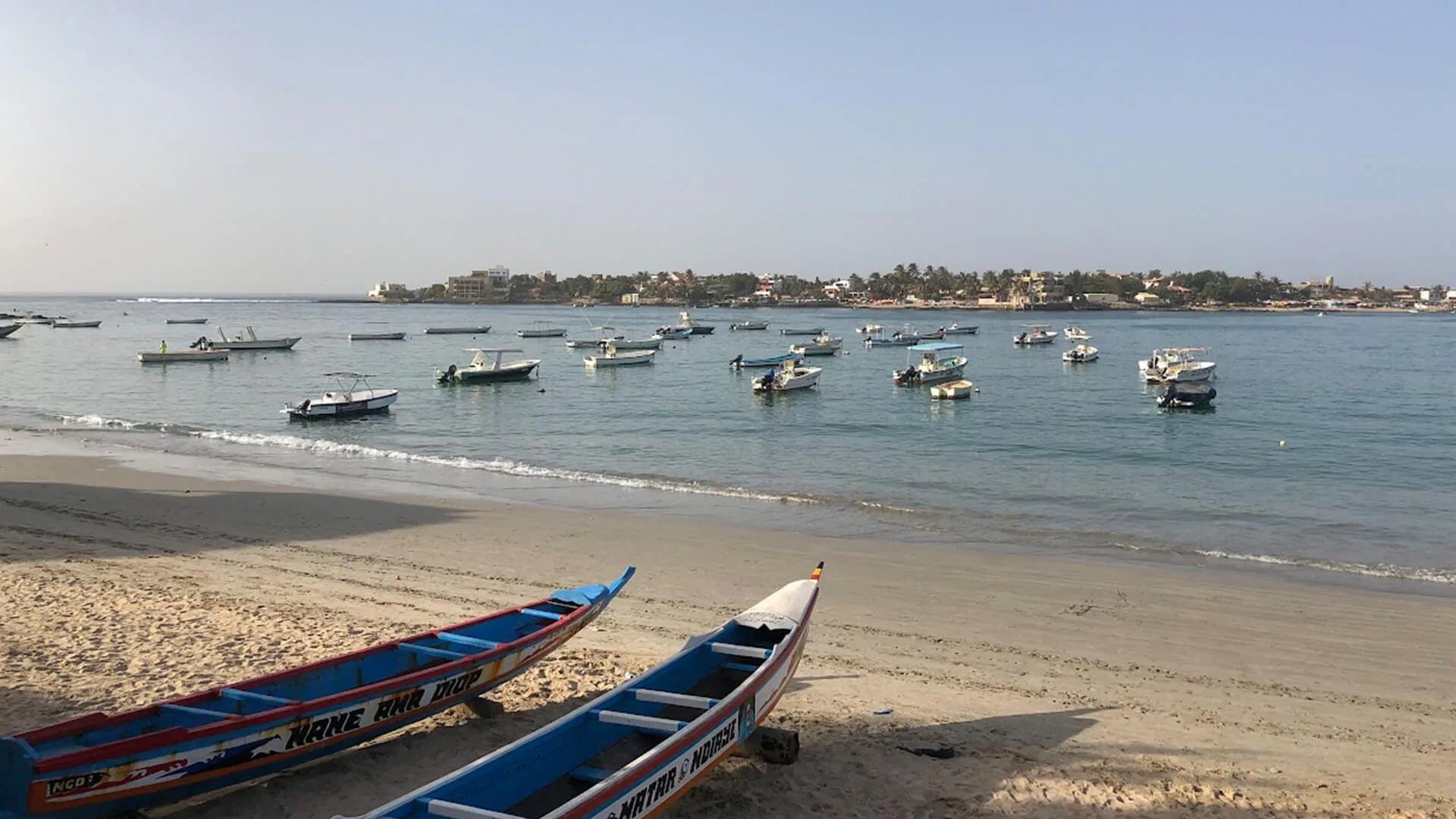
Traditional pirogue building remains one of the clearest expressions of this heritage. These long wooden fishing boats, often painted in vivid blues, reds, greens, and yellows, are practical tools but also moving works of art. Their shapes reflect generations of adaptation to Atlantic swell, coastal currents, and nearshore reef. Their painted motifs may include blessings, names, Qur’anic references, football clubs, or family symbols. Even today, when engines are common, the pirogue remains central to the visual and economic life of Ngor.
A village logic shaped by the ocean
Pre-colonial island life followed a marine rhythm. Men and older boys fished or worked boats, while women played key roles in processing, selling, and cooking the catch. Social life was structured around family compounds, elders, religious observance, and collective labour. The island’s lack of agricultural land made it especially dependent on exchange with the mainland, but this never meant isolation. Ngor was connected by sea routes long before modern roads linked Dakar’s neighbourhoods.
The physical landscape also shaped culture. Rocky edges, sandy pockets, reef shelves, and shifting Atlantic winds influenced where boats launched, where children swam, and where waves broke. The same reef formations that now attract surfers were first known by fishermen who read water texture, current lines, and tide movement with remarkable precision.
FACT: The breaks now called Ngor Right and Ngor Left were part of local ocean knowledge long before they became surf destinations. Fishermen understood these reef zones through navigation and seasonal sea conditions, not through surf terminology.
Colonial rule, Dakar’s expansion, and an island identity apart
French colonial expansion transformed the wider Dakar region from the nineteenth century onward. As Dakar developed into an administrative and commercial hub, the Cap-Vert peninsula changed rapidly. Ports, roads, military installations, and later urban sprawl brought new pressures and opportunities. Ngor, both the mainland village and the island offshore, became increasingly close to the city while retaining a distinct local identity.
This tension between proximity and separation still defines the island today. Dakar is visible from almost every shore, and yet the short boat ride creates a psychological distance that feels much greater than the actual crossing. During the colonial period, this separation helped preserve elements of village social life even as the mainland urbanised. The island served at times as a retreat, a fishing base, and a place where local customs remained more legible than in the fast-changing city.
After independence in 1960, Dakar’s population grew dramatically. Neighbourhoods spread westward, roads improved, and the Almadies area became associated with embassies, nightlife, and coastal development. This brought more day-trippers and domestic tourism to Ngor Island. Restaurants, pensions, and later surf lodgings emerged, but unlike many urban beach zones, Ngor Island kept its pedestrian scale. The absence of cars is not a gimmick. It is one of the reasons the island still feels socially coherent.
Urban pressure without total loss
Urban growth has inevitably altered local life. Property values rose, tourism created new forms of income, and younger residents gained access to global culture through phones, media, and travel. Yet fishing has not disappeared, and neither has the island’s role as a lived community rather than a resort enclave. You still see laundry drying between houses, children playing football in narrow sandy passages, and elders sitting in the shade discussing news and tides.
This balance matters. Ngor’s appeal comes precisely from the fact that it is not a fabricated surf village. It is a real Senegalese island community whose modern identity includes, but is not limited to, tourism. That is why travellers who stay on the island, rather than only visiting for lunch or a surf session, often understand it more deeply.
TIP: If you want to feel the island’s daily rhythm, walk at 7:00 am, 1:30 pm, and around 6:30 pm. Morning reveals fishing and school routines, midday slows for heat and prayer, and evening brings families outdoors and a softer social energy.
Islam in Ngor and the ethics of respectful travel
Like the rest of Senegal, Ngor is profoundly shaped by Islam, which is practised by the large majority of residents. Mosques are central to community life, not only as places of worship but also as social anchors. The call to prayer structures the day, and Friday carries particular importance. Even for non-Muslim visitors, awareness of this religious framework helps explain the island’s tempo, etiquette, and values.
Senegalese Islam is known internationally for its strong Sufi brotherhoods, especially the Mouride, Tijaniyya, and Qadiriyya traditions. In the Dakar region, Mouride influence is especially visible through work ethic, networks of solidarity, devotional practice, and respect for marabouts, or spiritual guides. On Ngor, these influences often appear less through formal explanation than through everyday conduct: greetings, modesty, patience, generosity, and deference to elders.
Religion here is lived, not staged. You may hear Qur’anic recitation from a home, see men heading to prayer in boubous, or notice businesses briefly pausing during prayer times. Visitors are welcome, but they should not treat these moments as spectacles. A respectful traveller understands that sacred life is not content.
Respectful visit tips
- Dress modestly away from the beach, especially in village lanes and near mosques
- Ask before photographing people, boats, homes, or religious spaces
- Keep noise low near prayer times, particularly on Friday afternoons
- Public affection is best kept discreet
- If invited into a home, remove shoes when appropriate and follow your host’s lead
EXPERT: Surfers often move between beach culture and village life quickly. Bring a shirt or cover-up for the walk back from the water. It is a small gesture that signals awareness and earns respect.
Teranga, hospitality as a social art
One of the most important words in Senegal is teranga. Often translated as hospitality, it means more than friendliness or good service. Teranga is a social ethic of welcome, generosity, and relational intelligence. It includes how people greet, share food, make space, offer help, and recognise the dignity of others. On Ngor Island, teranga is not a slogan for tourism. It is something you feel in repeated small interactions.
The word itself has deep roots in Wolof usage and carries connotations of warmth, openness, and honouring a guest. But teranga is not one-sided. It also assumes reciprocity. A guest should respond with gratitude, patience, politeness, and attentiveness. This matters for travellers. If someone takes time to explain directions, pours tea, or helps arrange a boat, the proper response is not entitlement but appreciation.
In practical terms, teranga often begins with greetings. Senegalese social etiquette places real value on saying hello properly before asking for anything. A simple exchange, “Bonjour, ça va?” or “Salaam aleikum”, can transform an interaction. Rushing straight to a request may seem efficient to a visitor, but it can feel abrupt locally. On Ngor, where life still moves at a human scale, these courtesies matter.
How teranga appears in daily life
You may notice teranga in the way meals are shared, often from a common dish, or in the way neighbours acknowledge one another while passing. It appears when someone offers a chair in the shade, or when a host insists you eat more fish than you thought possible. It also shapes professional hospitality. The best places to stay on Ngor understand that comfort should feel personal, not generic.
This is one reason Ngor Surfcamp Teranga fits the island so naturally. The name is apt. A good surf camp here is not just a bed near a wave. It should reflect local values through welcome, meals, guidance, and respect for the community. With daily breakfast and dinner, boat transfers, and a setting designed around both surf and Senegalese hospitality, it offers a practical way to experience the island without disconnecting from its culture.
CHECKLIST: Learn a few greetings in French or Wolof Carry small cash in XOF for boats and snacks Accept tea or conversation when time allows Say thank you, often and sincerely
The Endless Summer and the making of a surf icon
Ngor’s place in global surf history was sealed by Bruce Brown’s film The Endless Summer, released in 1966. The documentary followed surfers Mike Hynson and Robert August on a globe-spanning search for perfect waves and perpetual summer. When the film reached Senegal, it introduced many viewers to a point of the map they had never heard of, and to a wave that looked improbably clean, warm, and uncrowded.
What the film actually showed was not mass tourism or a developed surf town. It captured a simpler coastal world, where the wave now known as Ngor Right peeled along the reef with long, elegant walls. The sequence helped establish a powerful image: Africa not as a blank surf frontier, but as a place with world-class waves and a distinctive local atmosphere. The film’s framing was inevitably shaped by its era and by outsider eyes, but its impact was undeniable.
For decades, Ngor occupied a special place in the imagination of travelling surfers. It was not just another point break. It was part of surf mythology. That mythology brought visitors, stories, and eventually businesses built around surf access. Yet unlike some famous breaks that became overbuilt or detached from local life, Ngor retained a strong sense of place. The wave became famous, but the island remained inhabited and culturally grounded.
What surfers should know about the famous waves
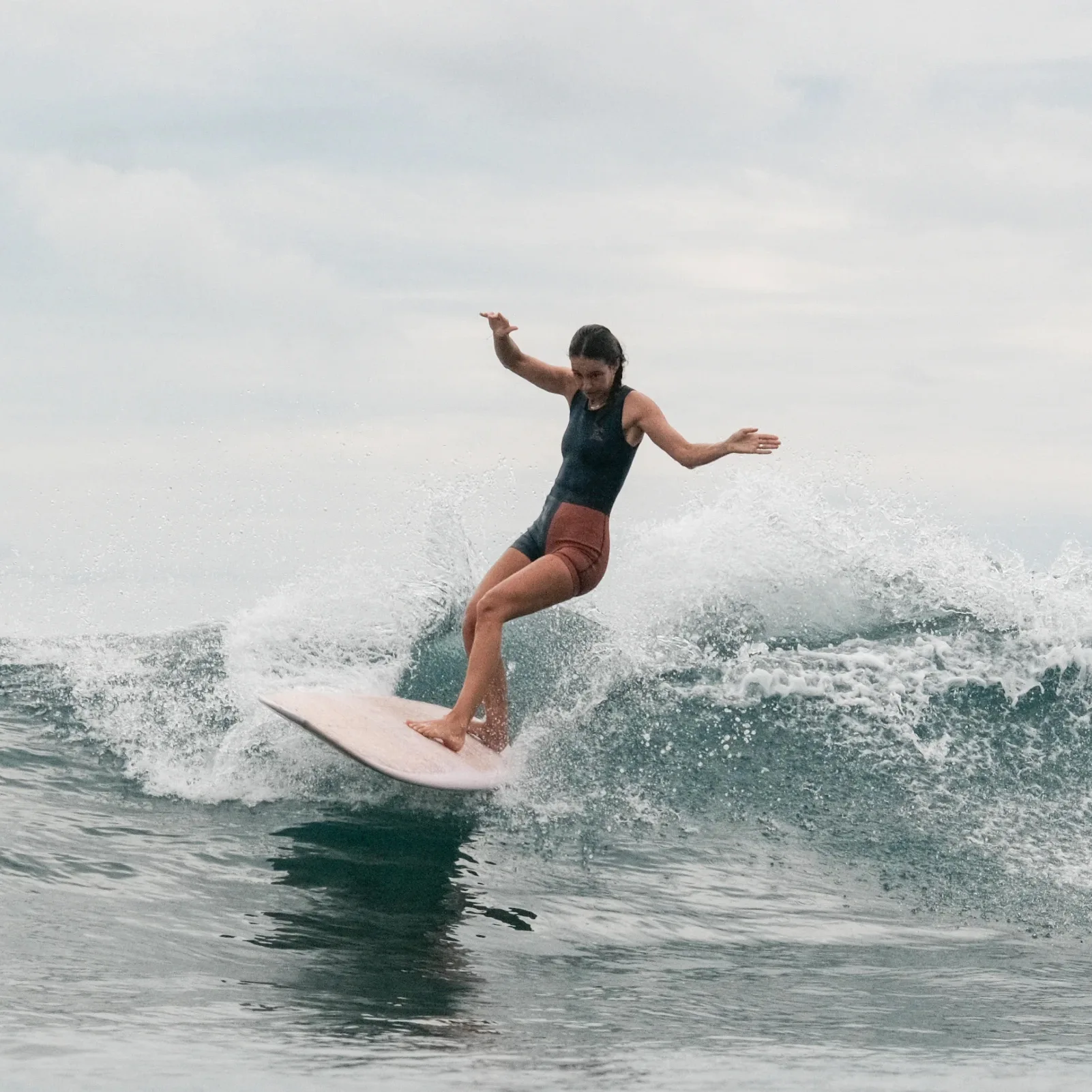
Ngor Right is the headline break, a powerful right-hand point/reef wave best suited to intermediate to advanced surfers depending on swell, tide, and crowd. It can offer long walls and fast sections, but it demands positioning, confidence, and respect for priority. Ngor Left, by contrast, is generally more forgiving and accessible to a wider range of surfers, including progressing beginners in the right conditions.
This duality is one reason the island works so well for surf travel. Different levels can often find suitable water time in the same area, especially with local guidance. A quality operation such as Ngor Surfcamp Teranga, licensed by the Senegalese Federation of Surfing, adds real value through daily surf guiding and video coaching, helping guests understand not only the wave mechanics but also local etiquette and timing.
FACT: The Atlantic around Ngor receives swell from the North Atlantic seasonally, with surfable conditions often strongest from November to March, though waves can appear outside that window depending on storms and local wind patterns.
Modern surf culture, institutions, art, music, and food
Surfing in Senegal is no longer a curiosity. It is an established and growing part of coastal life, with local clubs, youth participation, competitions, and international links. Senegal is connected to the global sport through the ISA, the International Surfing Association, and through the work of the Senegalese Surf Federation. These structures matter because they support coaching, event organisation, standards, and recognition for Senegalese athletes.
Local surfers have played a major role in turning Ngor into more than a heritage break. They are competitors, coaches, board shapers, guides, and cultural bridges. Many grew up reading the ocean through fishing families or beach life before entering formal surf pathways. Their presence has helped prevent the island from becoming merely a foreign fantasy. Surf here is lived locally, not just consumed by visitors.
The surf economy has also integrated into everyday island life in practical ways. Boatmen transfer surfers and luggage. Families rent rooms. Cooks prepare meals for camps and guesthouses. Young people find work in guiding, photography, hospitality, and transport. This integration is healthiest when tourism supports local livelihoods without overwhelming the community. Choosing licensed, locally connected operators helps.
Art in the lanes and the Porte de Ngor tradition
Ngor’s visual culture deserves attention beyond the water. Murals, hand-painted signs, and improvised street art add colour to the island’s walls and passageways. Some works celebrate surf, some depict fish, boats, or musicians, and others are simply expressions of neighbourhood pride. The island’s small scale makes these details easy to miss if you hurry.
One particularly evocative tradition is the Porte de Ngor, the painted door. Doors on or associated with Ngor are often treated as surfaces of personality and memory, with colour, motifs, and weathering that tell stories of households, tastes, and time. For photographers and writers, these doors are a reminder that island identity is built from domestic detail as much as from famous waves.
Rhythm, flavour, and shared time
Music and food are inseparable from understanding Ngor. In Dakar and across Senegal, mbalax remains the defining popular rhythm, built from sabar drumming traditions and modern instrumentation. Even when music is playing softly from a phone or café speaker, it shapes atmosphere. The beat can feel both urban and ancestral, fitting for an island suspended between village continuity and city influence.
Food is equally central. Senegal’s national dish, thiéboudienne, combines fish, rice, and vegetables in a deeply flavoured, communal meal that reflects the country’s maritime and culinary identity. On Ngor, seafood is naturally abundant, and meals often revolve around the day’s catch. Expect grilled fish, yassa sauces, rice dishes, fresh bread at breakfast, and fruit when in season. A hearty local meal on the island may cost 3,500 to 8,000 XOF, while tea or coffee is much less.
No cultural guide would be complete without attaya, the strong, sweet green tea prepared in three rounds. The ceremony takes time and is part of the point. Tea is conversation, patience, and social glue. If someone offers attaya, you are being invited into a slower register of island life.
TIP: If you are invited to share attaya, do not rush off after the first glass. The sequence matters, and staying a little longer often leads to the best conversations of the day.
Visiting respectfully and understanding Ngor today
Ngor Island today is a layered place. It has a resident population in the low thousands, though numbers fluctuate with season, family networks, and short-term stays. The fishing fleet still operates, and the island remains tied to the mainland through daily labour, schooling, and supply routes. At the same time, mobile phones, international guests, surf media, and Dakar’s growth have made Ngor unmistakably modern.
This coexistence of old and new is visible everywhere. Traditional pirogues sit near guesthouses with Wi-Fi. Children may switch between Wolof, French, and global pop culture references in a single afternoon. A surfer carrying a shortboard passes a fisherman repairing nets. The point is not that one world replaced another. It is that Ngor continues to negotiate both.
For travellers, this means responsibility. The island is not an open-air museum, and it is not a private surf resort. It is a living community. Respectful tourism helps preserve the qualities that make Ngor meaningful in the first place.
Dos and don'ts for visitors
- Do greet people before asking questions or taking services.
- Do support local businesses, boatmen, artists, cafés, and guides.
- Do ask before taking photos, especially of people at work.
- Do dress with awareness when away from the beach.
- Do keep the island clean, including cigarette butts and plastic bottles.
- Don’t treat village spaces as party zones late at night.
- Don’t assume every wave is for your level, especially at Ngor Right.
- Don’t bargain aggressively over small sums that matter locally.
Practical island basics
- Boat crossings usually run throughout the day, often from early morning until evening, weather permitting
- Carry cash, as card payment is limited and ATMs are on the mainland
- Walking shoes or sandals help on uneven sandy and rocky paths
- Surfboard transport may cost extra on local boats
- Distances are short, but heat can be intense from 12:00 pm to 3:00 pm
For those coming primarily to surf, staying on the island makes a major difference. Dawn checks are easier, the atmosphere is calmer, and you experience Ngor beyond the day-trip window. Ngor Surfcamp Teranga is especially well placed for this. With pool access, sea views, daily meals, and organised surf logistics, it allows visitors to focus on the water while remaining rooted in the island’s social environment. The added value of video coaching is significant, particularly on technically demanding reef waves.
EXPERT: Ngor Right is best approached with humility. Watch the line-up first, note take-off zones, and ask local guides about tide and entry. A single well-timed session is better than paddling out blindly and wasting energy.
SUMMARY: Ngor Island is a rare place where fishing heritage, Islamic life, painted streets, Atlantic surf history, and Senegalese hospitality still meet at close range. It is small, walkable, and famous, yet still deeply local. To appreciate it fully, move slowly, greet warmly, eat what is offered, and treat the island as a community before a destination. If you want the best base for doing that while surfing Ngor Right and Ngor Left, book with Ngor Surfcamp Teranga and experience the island with local knowledge, comfort, and genuine teranga.
Nej. Gorée (UNESCO-listet) er en separat ø med sin egen historie og færgelogistik. Ngor ligger ud for Almadies-området og nås med korte strandbåde.
Det er året for den teatermæssige udgivelse af The Endless Summer, dokumentaren der påvirkede global surf rejse og fremhævede Senegal blandt andre destinationer.
Spørg først. Mange scener er privatliv, ikke et forlystelsesparksæt.