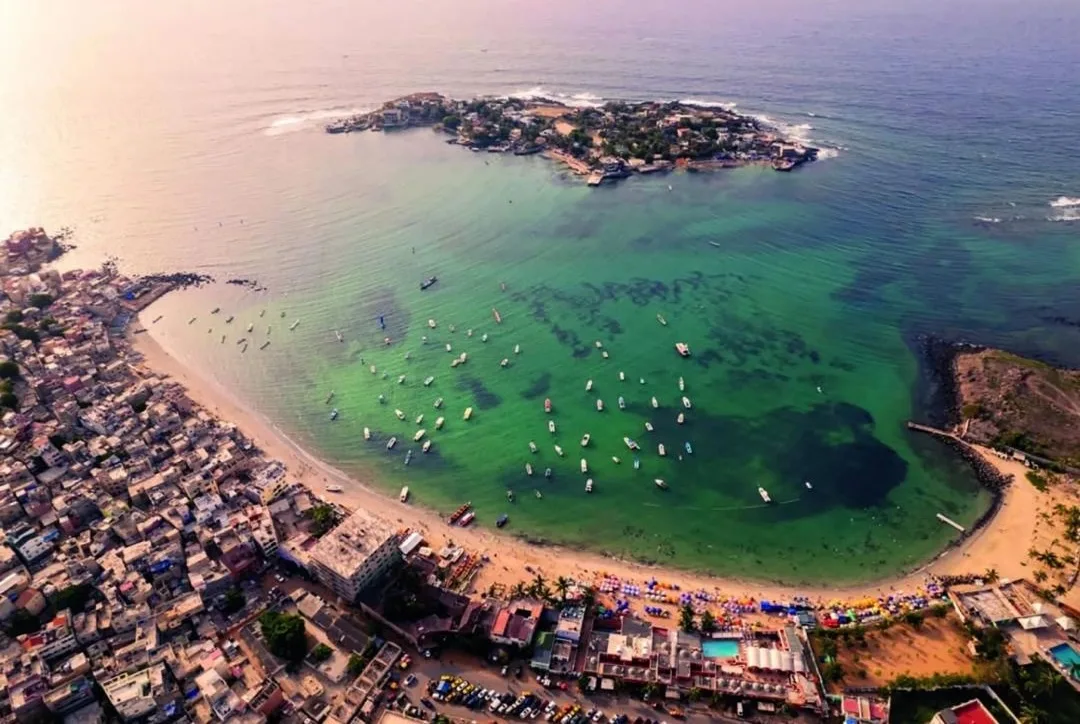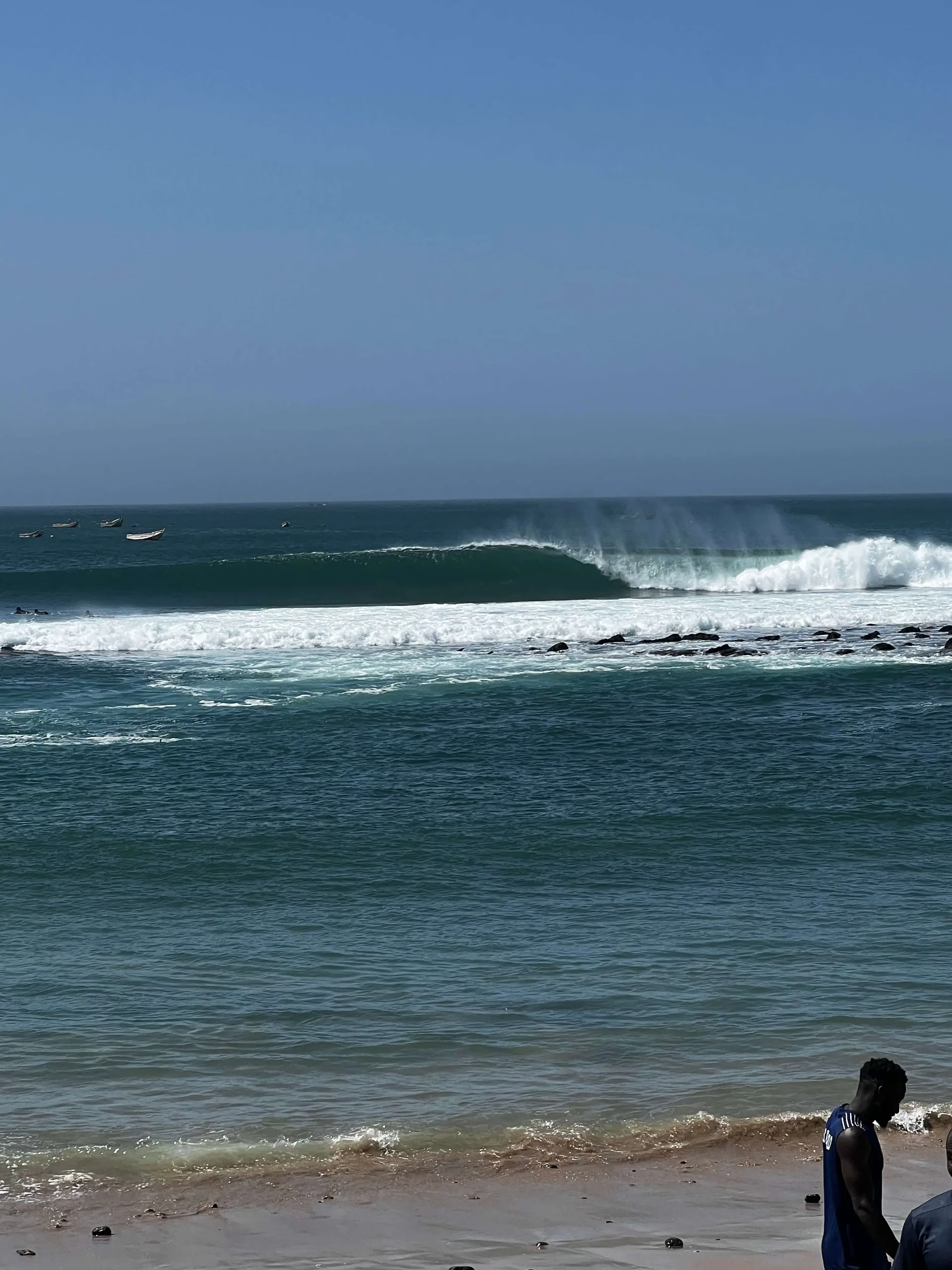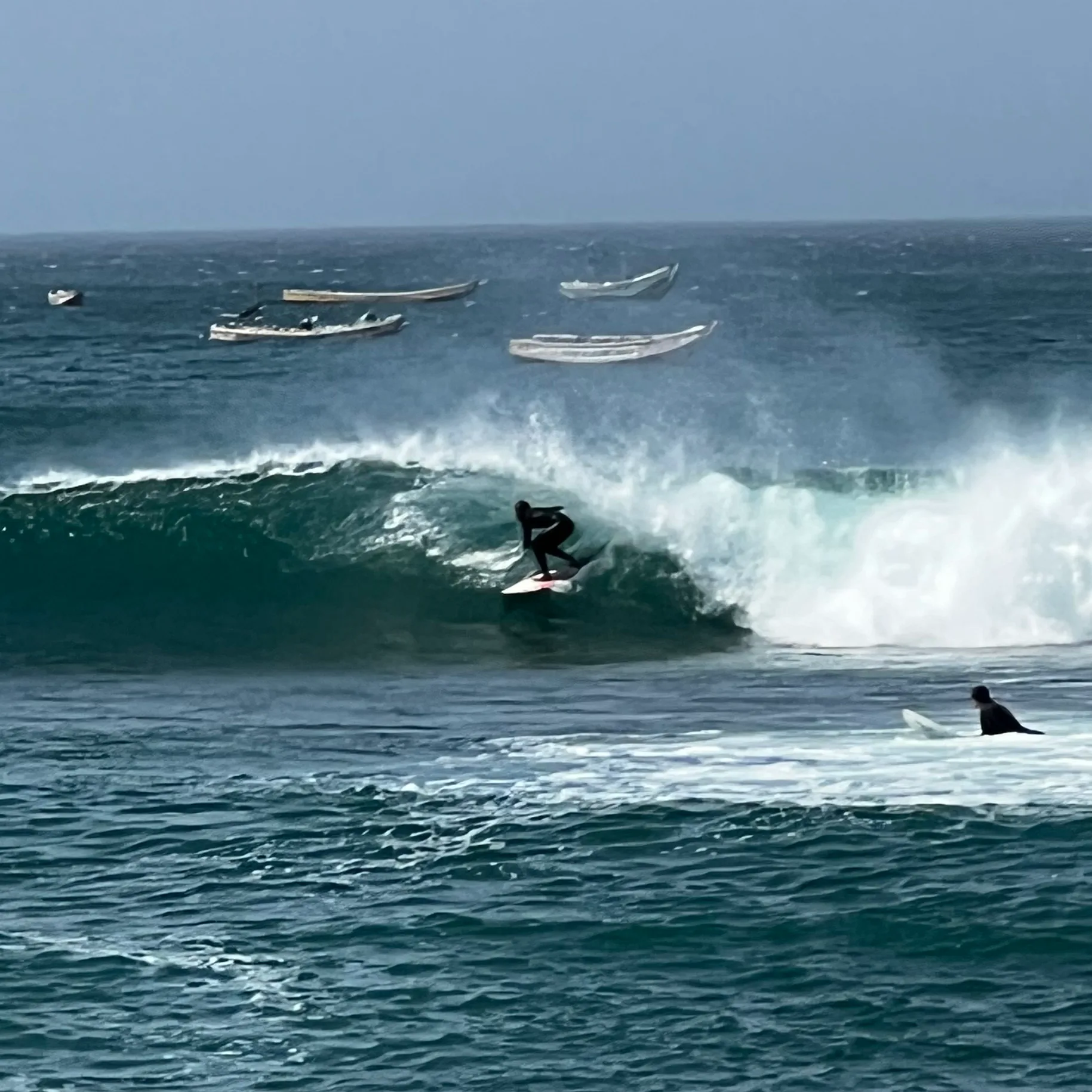
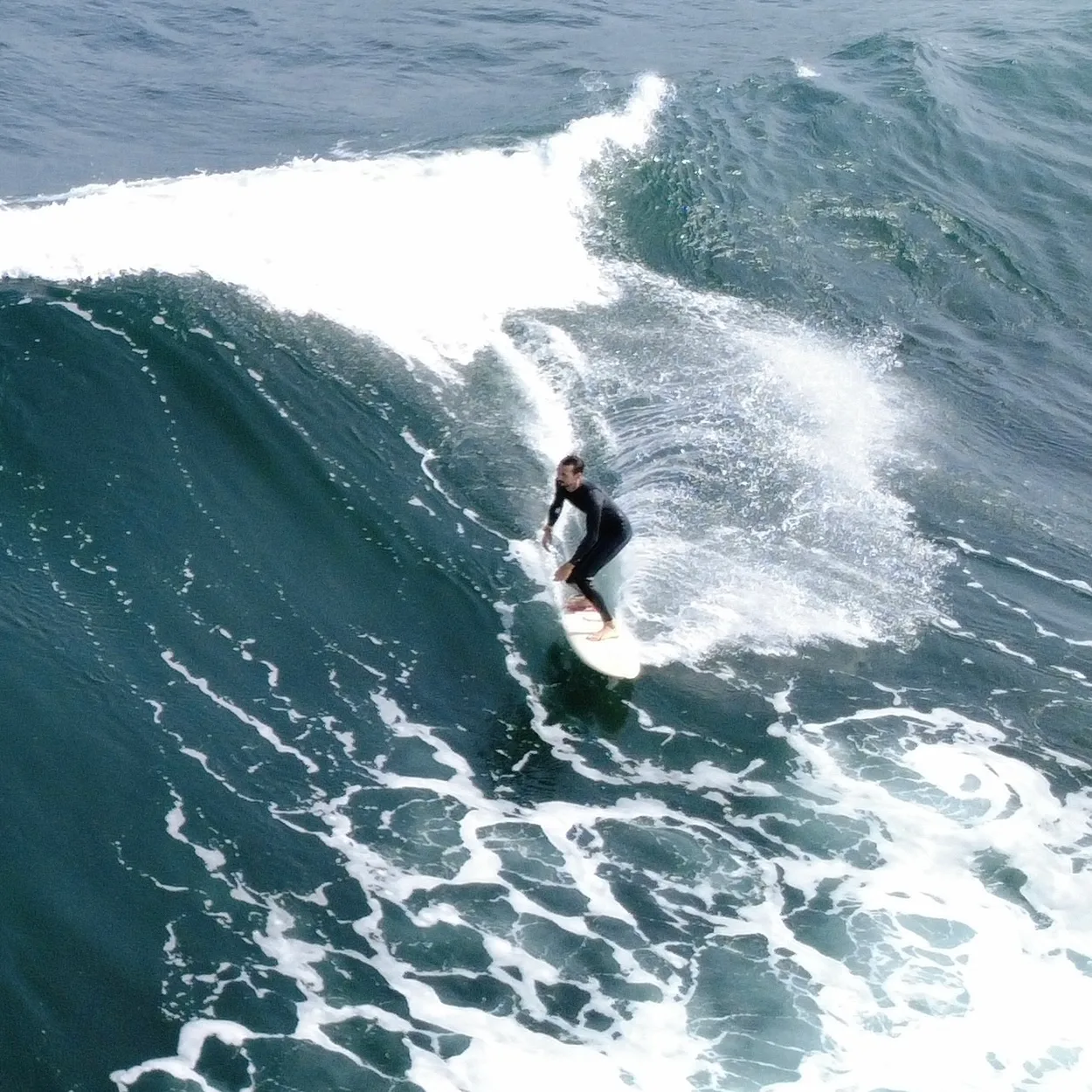
Off the coast of Dakar, a small island holds a unique chapter in West Africa's surfing history. N'Gor, just a few hundred meters from Les Almadies, is now renowned worldwide for its famous right-hand wave, its island vibe, and the swells that draw surfers from every continent.
But before the term Surf Camp Before becoming synonymous with a surf trip to Senegal, the island was first and foremost a village oriented towards the ocean.
Fishing, pirogues, currents, tides, and knowledge passed down through generations have long made the sea the heart of local life.
Then, in the 1960s, a few images would forever change the destiny of N'Gor.
Those of two Californian surfers gliding on the waves of Dakar inThe Endless SummerSurf Camp Ngor Senegal
Since then, several generations of surfers, guides, instructors, and entrepreneurs have contributed to shaping the history of surfing in N’Gor.
N'Gor Before Surfing : An Island Facing the Ocean
Long before the arrival of modern surfing, N’Gor lived to the rhythm of the Atlantic.
The island belongs to a territory deeply connected to the Lebou culture and fishing. The pirogues are part of the landscape, as are the departures to sea, the return of the fishermen, and the knowledge of ocean conditions.
For the locals, the ocean was not a playground.
It was a source of life.
This ancient relationship with the sea is key to understanding N’Gor’s unique identity. When the first foreign surfers discovered its waves, they arrived in an environment where the ocean was already at the heart of daily life.
Surfing doesn't create the connection between N’Gor and the sea.
It comes to add to it.
The 1960s : N’Gor Makes Surfing History
The international history of surfing in N’Gor is closely tied to Bruce Brown.
In 1964, the American filmmaker embarked on a world tour with surfers Robert August and Mike Hynson in search of waves and conditions to extend the summer.
The journey will give birth toThe Endless SummerReleased in 1964 and widely distributed in 1966, the film travels through Senegal and helps introduce Dakar's waves to an international audience.
The famous Ngor Right then emerges in the collective imagination of surfing.
For a generation of surfers, Dakar becomes a distant and exotic destination: a West Africa still largely unknown to the surfing world, with reef breaks, warm water, and a culture completely different from that of California or Europe.
This media exposure will give N'Gor a special aura that will never truly fade away.
An important note about The Endless Summer
Over time, some stories about the film have been simplified.
The famous sequence of the "perfect wave" often associated withThe Endless Summerwas not filmed in N’Gor, but in Cape St. Francis, South Africa.
On the other hand, the film thoroughly documented Robert August and Mike Hynson's journey to Senegal and helped introduce N’Gor’s waves to the global surfing community.
It is this distinction that allows us to tell the story of N’Gor without fueling a legend that has grown larger than the facts.
After The Endless Summer a destination that remains under the radar
The release of the film doesn't instantly turn N’Gor into an international seaside resort.
For several decades, surfing remained a relatively niche activity in Senegal.
Foreign surfers are starting to come and explore Dakar and its various surf spots.
For many, travel retains an adventurous edge.
You need to know the best spots to surf, find equipment, organize transportation, and understand the local conditions.
At that time, the surf tourism ecosystem we know today did not yet exist.
No online booking.
No surf weather app.
No international surf camp network.
Knowledge of the waves is mostly passed on through encounters, regulars, and the surfers present on-site.
And it is precisely this human dimension that will help shape the Dakar surf scene.
The first Senegalese surfers
The history of surfing in N’Gor cannot be told solely through the lens of foreign travelers.
Starting in the 1990s, Senegalese pioneers began surfing with increasing regularity.
Among them are notably Patina Ndiaye, Oumar Sèye, and Pape Samba Ndiaye, who will play a significant role in the development of local practice.
Some tell stories of starting with very limited means: salvaged gear, broken boards, or hard-to-find equipment.
Surfing is still sometimes seen as a foreign activity.
But gradually, things are changing.
Surf is becoming a true local culture.
Young people from N’Gor and Dakar get closer to the waves, watch foreign surfers, and start grabbing their own boards.
This evolution will be decisive for the course of history.
The 2000s : The Birth of a True Surf Economy
It wasn't until the 2000s that a much more structured surf scene began to emerge in Senegal.
Foreign visitors are increasing in number.
Getting around just got easier.
The equipment is circulating more frequently.
And above all, surfers are starting to turn their passion into a professional career.
It is in this context that the concept of Surf Camp truly comes to life.
A surf camp fulfills several needs at once:
- find accommodation close to the waves;
- rent or use equipment;
- get local advice;
- organize transportation;
- discover multiple surf spots;
- meet other surfers;
- enjoy a simpler experience than organizing a solo trip.
The surf camp thus becomes a gateway between international travelers and the local surf scene.
2004 : One of the first structured surf camps in N’Gor
The documented history of surf camps on the island notably includes Ngor Island, which claims to have opened in 2004.
Specialized sources present it as one of the oldest surf operators established in Senegal.
This period is important.
Surfing is no longer just an individual adventure.
It is gradually becoming a true tourist experience.
Visitors can now stay on the island, surf the waves in front of the camp, and set out to explore other surf spots around Dakar.
The concept of Surf Camp then began to take a shape close to what travelers know today.
Why set up a surf camp in N’Gor ?
Choosing N’Gor is almost a no-brainer for a surfer.
The island is located off the coast of Dakar, in close proximity to the Pointe des Almadies.
Facing the Atlantic, it benefits from an interesting exposure to swells.
Most importantly, several waves are just a short distance away.
The most famous is undoubtedly the right-hand break of N’Gor.
But the region also has many other spots, with different orientations and characteristics.
This concentration of waves around the Cap-Vert peninsula is one of the major advantages of a Surf Camp in N'Gor
When the wind or swell aren't favorable at one spot, it's possible to seek better conditions elsewhere.
It's the very essence of a surf trip.
The surf camp becomes a surf base
Over the years, the surf camp's role has evolved.
Originally, it was mainly about offering a place to sleep near the waves.
Then services began to expand.
Accommodation, meals, board rentals, transportation, surf lessons, surf guiding, and session organization gradually enhance the experience.
The camp becomes a true surf base Surf Camp Ngor
This evolution accompanies Dakar's transformation into an international surf destination.
##
One of the most important elements of this story is undoubtedly the community.
It's a place where the following come together:
- international surfers;
- instructors;
- fishermen;
- travelers;
- island inhabitants.
Conversations often start with a simple question:
"How's the swell ?"
Then comes the wind, the tide, the best spot of the day, and the forecasted conditions for tomorrow.
This culture of sharing is at the heart of the identity of historic surf camps.
Local surfers take their spot
As surf camps continue to grow, the Senegalese surf scene is also evolving.
More and more young people are discovering surfing.
Surf clubs are emerging.
Local instructors are becoming professionals.
Emerging competitors.
Structures like Take Off Ngor contribute to this momentum and the passing down of surfing to new generations.
Today, Senegalese surfing has its own champions, clubs, coaches, and a new generation dreaming of international competition.
So surfing is no longer just a story brought in by visitors.
It now fully belongs to the country's sporting culture.
From the historic surf camp to the next-generation Ngor Surf Camp
Travelers' expectations have also evolved.
Today's surfer is always in pursuit of the perfect wave.
But he often desires more comfort than twenty years ago.
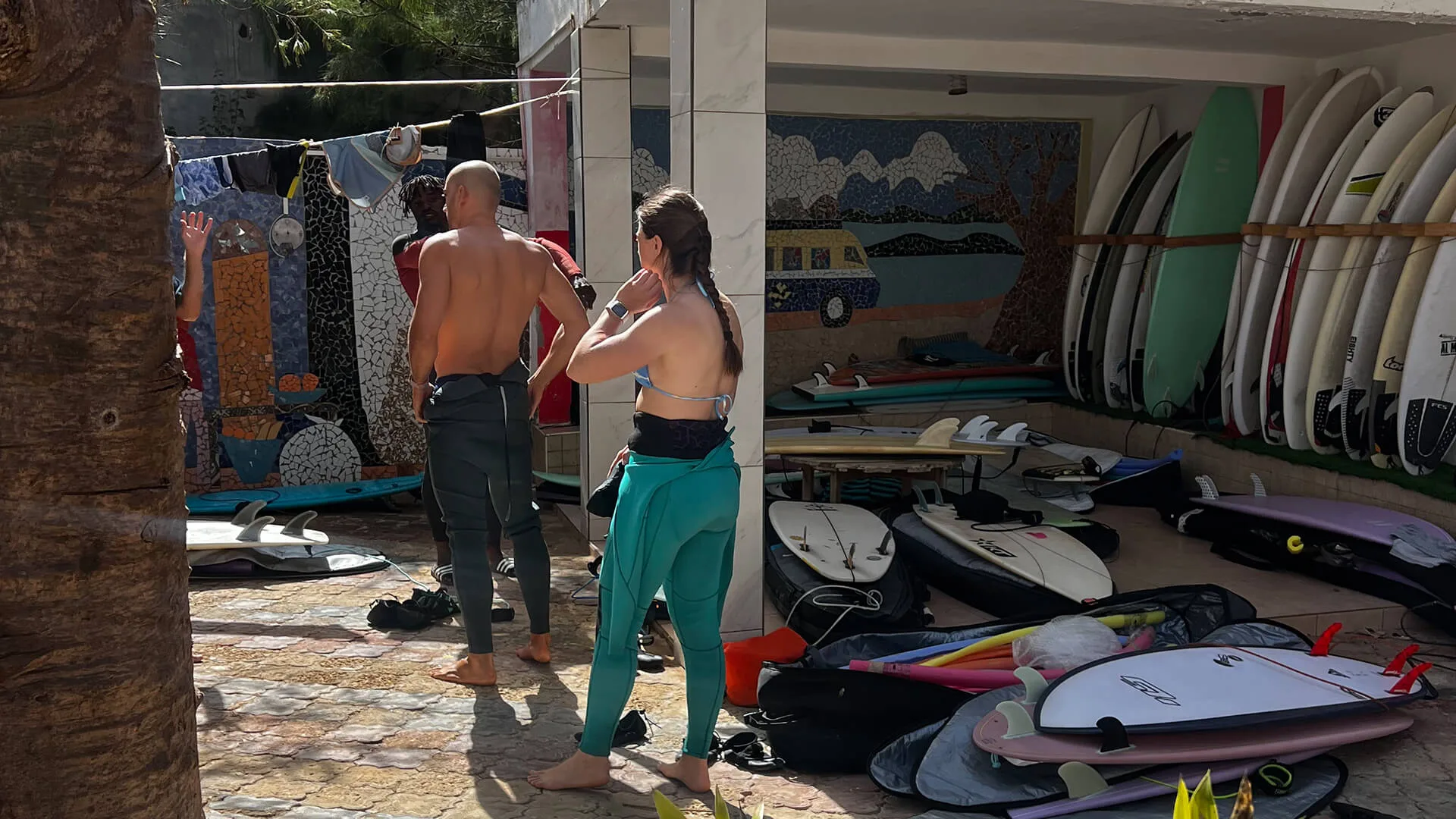
Modern surf camps offer private rooms, relaxation areas, a swimming pool, local cuisine, Wi-Fi, equipment, and personalized coaching.
The Surf Camp contemporary is therefore situated at the intersection of two worlds.
On one side, the history and authenticity of N’Gor.
On the other hand, the expectations of an international clientele accustomed to traveling easily and booking their stay online.
The challenge lies in modernizing the experience without losing the soul of the place.
Ngor Surfcamp Teranga : Writing the Next Chapter
It is within this new generation that we find ourselves today Ngor Surfcamp Teranga
The idea is to preserve what makes a surf camp in N'Gor historically unique: oceanfront access, community spirit, shared surf sessions, and immersion in local culture.
But with a more contemporary approach to the stay.
Comfortable accommodation, private rooms, pool, Senegalese meals, surf lessons, surf guiding, and equipment rental come together to create a complete surf experience.
The goal is not to turn N’Gor into an artificial destination.
On the contrary.
The goal is to allow travelers to discover the island as it truly is: a small community oriented towards the ocean, located just minutes from Dakar, with a surfing history that spans generations.
A story that continues with every new swell
More than sixty years after Bruce Brown and the surfers fromThe Endless Summer, the right side of N'Gor continues to work like a magnet.
Surfers always look to the horizon.
The pirogues continue to cross between the island and Dakar.
Young Senegalese continue to discover surfing.
And travelers keep arriving in N’Gor with the same question:
"Where are the waves ?"
The difference is that today, they can stay in a Surf Camp Meet local guides, discover multiple surf spots, and experience it from the inside.
The history of surf camps in N’Gor is not just about a tourist activity.
It's the story of a meeting between an island, an ocean, a local culture, and an international community of surfers.
The first images ofThe Endless Summerin modern surf camps, one thing has never changed:
The ocean remains at the heart of everything.
And in N'Gor, every new swell writes another page of this story.